The Day the Root and the Power Swapped Places
Which comes first, the root or the power? For a Year 9 student staring at a fraction parked in the exponent position, that is a genuine decision. Two routes, one answer. That single fact is what the whole Mathematics unit on rational exponents was built around.
Two Doors to the Same Number
The topic was rational exponents, the bridge between exponential notation and radical notation. The denominator names the root, the numerator names the power, so sixteen to the power of one half means the square root of sixteen, which is four. Eight to the power of two thirds is kinder if you take the cube root first and square afterwards, but squaring first works too. Both roads arrive at four.
Ms Ranti did not open by handing over those sentences. She put the examples up and let the class hunt the pattern: compare the powers of sixteen, notice what the bottom number keeps doing, try a case that seems to break, then say the rule in their own words before writing it down. Talk ran beside practice throughout, and the work closed as a sheet the students built in Numbers.
The Rule They Wrote Themselves
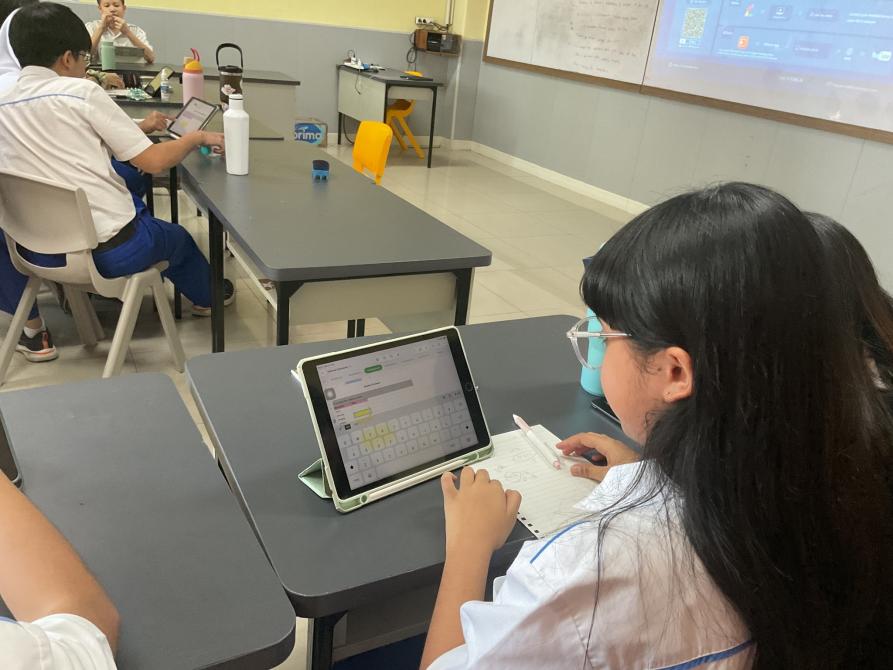
The pattern hunt was the main activity, not a warm-up before the serious copying began. Choosing the order that makes a calculation easier is student choice with real mathematical consequences, since it asks a child to know which route suits how they think. Nothing was accepted on faith either. A result was checked by running the operation backwards: if the square root of eighty-one is nine, then nine squared must walk home to eighty-one. That is critical thinking fitted with its own safety net, and it grew quietly into intellectual independence, because the student decides whether an answer looks reasonable instead of waiting to be told.
Reasoning then had to be spoken and written so another person could follow it, which is what attention to audience means inside a Mathematics classroom. During the discussion, students compared two orders out loud and argued for one, honest group work between neighbours. The worksheet left behind is what it looks like when students create products instead of filling blanks.
Ask About the Second Route
Somewhere in that year group is a student who insists on rooting first and another who squares first every time. Ask your child which order they chose and why, then ask them to check one answer in front of you, running the operation backwards. If they can teach you the trick, say so to Ms Ranti: lessons built that way are worth keeping.