From Abstract Variables to Digital Precision
Have you ever looked at a mathematical equation and seen a piece of art waiting to happen? Usually, algebra feels like a jumble of letters and numbers on a messy scratchpad. But in this recent Mathematics project, the script was flipped. The goal wasn’t just to solve for $x$ and $y$; it was to visualize logic with pinpoint accuracy.
The Detective Work of Algebra
In this Year B Math class, Ms. Ranti presented the students with a unique challenge: “Can you prove that an equation is actually a straight line?”
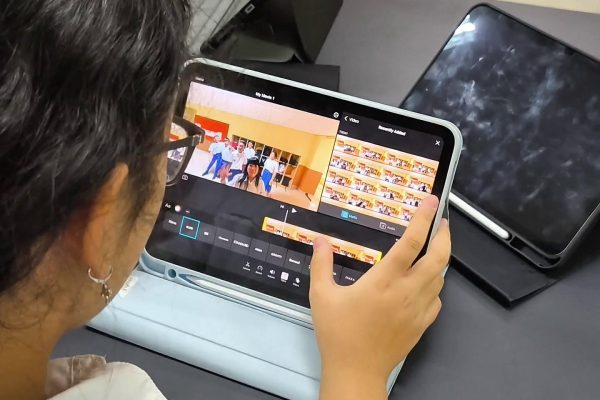
The mission began with the “Calculation Phase.” Students acted like data detectives, crunching numbers to find coordinate points that satisfied specific linear equations. But the learning didn’t stop at calculation. Once they had their data, the iPads came out, and the classroom transformed into a digital drafting studio.
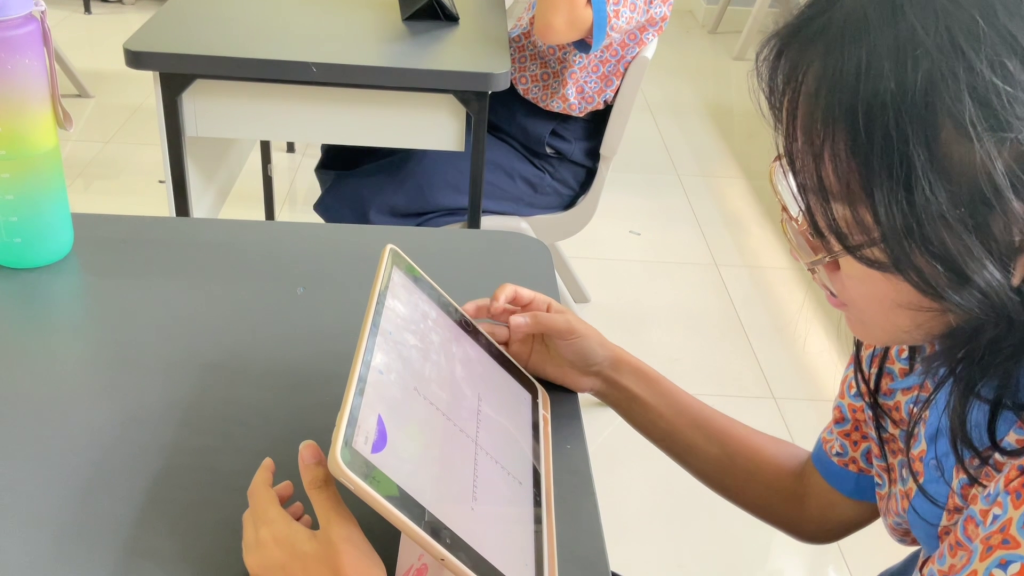
Using the Freeform app, students had to construct Cartesian diagrams from scratch. Ms. Ranti guided them to use the digital Ruler tool, not just as a straight edge, but as an instrument of precision to ensure perfect 90-degree axes. The climax of the lesson was the “Plotting Phase,” where students placed their calculated points on the screen and connected them. It was a moment of truth—if the line didn’t pass through all points perfectly, they knew they had to re-calculate.
Where Logic Meets Aesthetics


In this Year B Math class, Ms. Ranti presented the students with a unique challenge: “Can you prove that an equation is actually a straight line?”
The mission began with the “Calculation Phase.” Students acted like data detectives, crunching numbers to find coordinate points that satisfied specific linear equations. But the learning didn’t stop at calculation. Once they had their data, the iPads came out, and the classroom transformed into a digital drafting studio.
Using the Freeform app, students had to construct Cartesian diagrams from scratch. Ms. Ranti guided them to use the digital Ruler tool, not just as a straight edge, but as an instrument of precision to ensure perfect 90-degree axes. The climax of the lesson was the “Plotting Phase,” where students placed their calculated points on the screen and connected them. It was a moment of truth—if the line didn’t pass through all points perfectly, they knew they had to re-calculate.
What Does Your Child’s Graph Say?


This project proved that accuracy creates beauty. The students have moved beyond memorizing formulas to understanding how those formulas shape space. Tonight, try asking your child to show you their Freeform board. Ask them to explain how they knew exactly where to place those dots—you might get a fascinating lesson on how they turned numbers into a perfect line.