Solving the Mystery of Colorless Liquids through Comics

Imagine three beakers sitting on a lab bench. All contain clear, colorless liquids. One might be harmless water, another a salt solution, but the third could be a corrosive acid or a strong base. How do you tell them apart without risking a dangerous taste test?
This wasn’t just a standard textbook problem in our Year 11 Chemistry class; it was an investigative mission waiting to unfold.
The Case of the Hidden pH
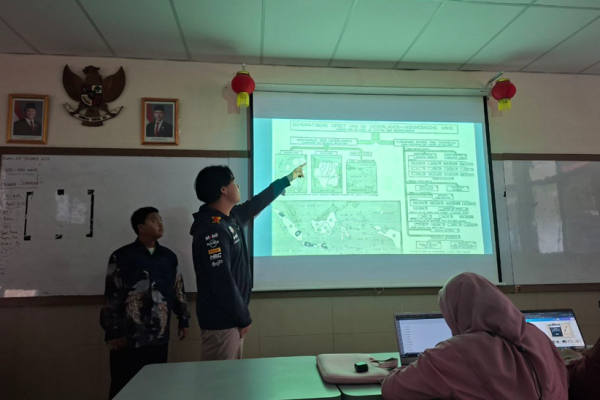
In this unique project, the classroom atmosphere shifted from a lecture hall to a detective agency. Ms. Diana challenged the students to look beyond the Periodic Table on the wall and dive into the practical application of Acid-Base indicators.
The mission was clear but complex: analyze different solutions using tools like litmus paper, methyl red, and phenolphthalein. However, the twist lay in how they had to report their findings. Instead of a traditional, dry lab report, the students were tasked with documenting their journey using Keynote to create an interactive comic strip.
Working in small, agile squads, the students navigated through a simulation where they had to predict reactions and identify the mystery solutions. They weren’t just memorizing color changes; they were visualizing the chemical story.
Where Science Meets Storytelling


What looked like fun with digital comics was actually a rigorous exercise in deep learning. By transforming their analysis into a visual narrative, the students were effectively combining multimodal communication. They had to decide how to weave text, scientific symbols, and character dialogue to make complex chemical concepts understandable and engaging.
The magic happened in the collaboration. As they huddled over their iPads, the students engaged in intense joint reasoning. They had to debate which indicator was the most effective for a specific pH range and justify their choices to their teammates before committing it to their comic plot. This required them to constantly evaluate evidence and correct each other’s misconceptions in real-time.
Furthermore, the freedom to design their own comic characters and plotlines allowed for significant student choice. Some groups turned the assignment into a game-show style reveal, while others treated it as a Sherlock Holmes-style deduction. This wasn’t just about getting the “right answer”; it was about creating a shared product that proved they understood the logic behind the chemistry, not just the definitions.
What’s Next?

By the end of the session, the students hadn’t just learned to identify an acid from a base; they had learned to communicate scientific truth with creativity.
Now that they have mastered the art of visual scientific storytelling, one has to wonder: how will they tackle the next complex topic? If you ask your child about their day and they mention turning a chemical reaction into a graphic novel, take a moment to look at their work—you might just learn something new yourself.